

Prediction market platforms can now use Google Ads to close much of the historical acquisition gap versus sportsbooks and iGaming operators, but only if the regulatory, tax, and licensing framework is correctly understood and operationalised.
With Google’s January 2026 policy shift, Exchange-Listed Event Contracts offered by federally regulated entities are now eligible to advertise across the Google Ads ecosystem in the United States.
For qualified operators and brokers, this creates a rare market window: Paid Search, Display, YouTube, and Performance Max inventory are suddenly available to a category that has historically operated in a marketing grey zone.
This article outlines how CFTC regulated prediction markets and NFA registered brokers can use Google Ads strategically, not just tactically, to compete against sportsbooks, exploit tax asymmetries, and build long-term category demand.
Google’s New Prediction Market Advertising Policy (Effective January 21, 2026)
From January 21, 2026, Google permits ads in the US for:
- Exchange Listed Event Contracts
- Offered by CFTC regulated platforms
- Or accessed via NFA supervised brokerages
- Listed on approved event contract exchanges
This immediately narrows eligibility to serious, federally supervised operators. State-licensed sportsbooks do not automatically qualify under this framework — and most non-regulated “prediction” products remain excluded.
For certified advertisers, this unlocks:
- Google Search
- Display Network
- YouTube
- Performance Max (PMax)
For the first time, compliant prediction markets can deploy the full Google Ads stack for scalable acquisition and brand expansion.
This essentially means you have access to advertise in California and Texas and sports betting adjacent product.
The Structural Disadvantage vs Sportsbooks
Historically, sportsbooks and iGaming operators have dominated paid media auctions for three structural reasons:
- Product depth (casino, live betting, same-game parlays, in-play)
- High-frequency usage cycles
- Robust lifetime values (LTVs) that justify aggressive CPAs – Note: Top tier CRM is required to unlock these LTVs.
Prediction markets, by contrast:
- Tend to have narrower event coverage
- Lack casino cross-sell
- Have fewer high-velocity betting moments
This creates a paid search imbalance. Big betting brands can outbid prediction market brands because their blended LTV supports it.
CFTC regulated event contracts sites do not have the bolt on of igaming to drive up revenues. In states where igaming is legal this represents a severe flaw in their business model.
Betting Tax: The Emerging Arbitrage Opportunity
The early sportsbook boom was partly funded by relatively benign tax environments in first-wave states. That dynamic is shifting.
States such as:
- New York
- Illinois
- And others trending toward higher GGR rates
Now impose effective tax burdens approaching or exceeding 50% when you factor in:
- Headline GGR tax
- Handle-based levies
- Per-bet charges
- Licence costs
- Compliance overhead
These tax structures materially suppress acceptable CPA thresholds for sportsbook operators in high-tax jurisdictions.
CFTC regulated prediction markets, by contrast, fall under federal derivatives oversight, not state gambling regimes. In many cases, this means:
- No state gaming tax
- No state gambling duty
- No state licensing stack
If a sportsbook must absorb 45–50% effective tax in a state and a federally regulated event-contract venue does not, the latter can tolerate materially higher acquisition costs while preserving contribution margin.
In paid search auctions, marginal economics win. This might level the field.
Why a State-by-State Google Ads Model Is Essential
Prediction market operators cannot deploy a single national Google Ads playbook.
Sports betting regulation in the US is fragmented. Tax rates, promotional rules, and marketing restrictions vary significantly by state. A disciplined approach requires:
- State-level ROI modelling
- Effective tax comparison vs sportsbooks factoring in any igaming
- Licence cost benchmarking
- CPC and CPA ceiling modelling
- Auction density analysis
In mature, high-tax sportsbook states, prediction markets may find profitable pockets of inventory where sportsbooks have reduced bid aggressiveness due to compressed post-tax margins.
This is not about blanket aggression. It is about selectively outbidding in the correct instances.
Example – Top Google Ads PRediction Market Ad Results in California

NFA Brokers as Google Ads-Driven Affiliates
Google’s policy does not only allow exchanges to advertise. It also permits certain intermediaries:
- NFA-registered brokerages
- Routing to CFTC-approved event-contract exchanges
This creates a powerful structural opportunity.
Brokers can operate effectively as:
- Performance-driven acquisition layers
- Multi-venue gateways
- Diversified distribution hubs
Instead of relying on a single operator’s Google certification, brokers can:
- Acquire users into regulated brokerage accounts
- Monetise trading activity
- Route order flow to multiple event-contract venues
In practical terms, this mirrors the affiliate model that powered iGaming growth over the last decade — but under a federally regulated derivatives framework.
Entering the Affiliate Layer with Google Ads
Licensed brokers can deploy proven acquisition tactics:
- Search campaigns targeting educational intent
(“how to trade election outcomes”) - First-party email capture funnels
- Grid-led landing pages
This model diversifies risk across:
- Multiple CFTC-regulated platforms
- Multiple verticals (politics, macro, commodities, crypto)
- Multiple user cohorts
It also reduces dependence on a single brand certification inside Google’s gambling and financial product review systems.
Early Semantic Matching Issues in Sports Terms
Initial campaigns in the prediction market category reveal a predictable issue: Google’s semantic expansion.
Broad and phrase match types tend to blur:
- “Prediction market”
- “Sports predictions”
- “Betting tips”
- “Free picks”
- “Sportsbook odds”
As a result, CFTC-regulated advertisers with limited sports event coverage may be triggered on:
- Mainstream betting queries
- Tipster traffic
- Bonus-seeking behaviour
The risks are:
- Depressed conversion rates
- Budget inefficiency
- Potential regulatory scrutiny if ads are perceived as gambling marketing rather than financial product advertising
This category requires tighter search governance than typical e-commerce or SaaS accounts.
Why Keyword Strategy Must Extend Beyond Sport
Prediction markets are not a sports product. They are an event-driven derivatives product.
The highest-value contracts often sit in:
- Macro (CPI, Fed decisions)
- Politics (elections, legislation)
- Rates and commodities
- Crypto
- Technology adoption
- Weather and climate
- Real estate indicators
A robust SEO and paid search strategy should map intent clusters across:
Financial Trading
- “event contracts on CPI”
- “trade Fed decision outcomes”
- “hedge rate cuts”
Politics
- “2028 election odds”
- “trade election results legally”
Macro Hedging
- “hedge unemployment risk”
- “inflation scenario trading”
Niche Domains
- “hurricane landfall contracts”
- “AI regulation vote date”
Structuring campaigns around these differentiated verticals avoids direct collision with sportsbooks on NFL and NBA inventory — and instead aligns spend with the most defensible parts of the product suite.
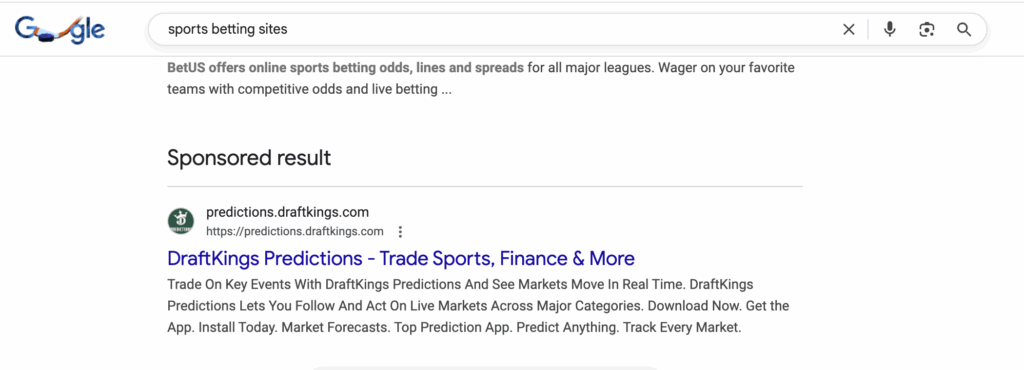
That being said, in jurisdictions without regulated sports betting like California, high value sports terms can be targeted.
For example, here is an ad result for Draft Kings Predictions in from California.
Taming Match Types and Negatives
Prediction market advertisers should adopt a more disciplined match-type structure:
Prioritise:
- Exact match
- Tightly structured phrase match
- Product-specific long-tail terms
Examples:
- “prediction markets USA”
- “CFTC regulated event contracts”
- “[Brand] event exchange”
Aggressively Exclude:
- “free picks”
- “parlay”
- “same-game”
- “no deposit bonus”
During the first 60–90 days, weekly search-term audits are essential. The objective is to:
- Eliminate betting-adjacent waste
- Reallocate spend into macro and financial verticals
- Protect compliance posture
Final Strategic Takeaway
Prediction market paid search advertising on Google Ads is not a simple “gambling vertical” play.
It is a regulatory arbitrage opportunity combined with a category-building exercise.
Success requires:
- CFTC and NFA compliance alignment
- State-by-state tax modelling
- Auction-level CPC discipline
- Strict search term governance
- Brand defence strategy
- Multi-vertical keyword architecture
Operators and brokers that approach Google Ads with financial-market discipline, not sportsbook mimicry, are best positioned to capture the structural inefficiencies now emerging in the US paid media landscape.
The window is open. It will not remain inefficient indefinitely.
Arrange a call with us to discuss how we can help you